Healthy cultures are already defined
Healthy culture is not a "vibe." It is a set of observable features, studied for decades in industrial and organizational psychology. You can walk into a company and look for signs of health.
Do people share vulnerability or do they posture?
Is there psychological safety or do people manage perceptions?
Do people feel belonging or do they feel disposable?
Is there an established purpose or is everyone just executing tasks?
Healthy cultures are not common, but they are not mysterious either. They are well understood. Researchers have reported on them for decades.
Do people share vulnerability or do they posture?
Is there psychological safety or do people manage perceptions?
Do people feel belonging or do they feel disposable?
Is there an established purpose or is everyone just executing tasks?
Healthy cultures are not common, but they are not mysterious either. They are well understood. Researchers have reported on them for decades.
Strong cultures are different
A healthy culture answers the question: is this environment good for humans?
A strong culture answers a different question: is this environment distinctive?
Strong cultures are highly idiosyncratic, on purpose. They both repel and attract talent. They are not vanilla. They take a stance, often controversially.
A strong culture answers a different question: is this environment distinctive?
Strong cultures are highly idiosyncratic, on purpose. They both repel and attract talent. They are not vanilla. They take a stance, often controversially.

Think about Traba’s “996” expectation. Now compare that to Basecamp’s “summer Fridays off.”
Neither is inherently good or bad. But both are clearly strong. They communicate what the company values. They create a point of view. They sort people.
A weak culture is what you get when you avoid taking a stance. It is the standard 9 to 5 weekday policy. The generic values on the website. The hand wave of “we work hard and have fun.”
It is culture by default.
Neither is inherently good or bad. But both are clearly strong. They communicate what the company values. They create a point of view. They sort people.
A weak culture is what you get when you avoid taking a stance. It is the standard 9 to 5 weekday policy. The generic values on the website. The hand wave of “we work hard and have fun.”
It is culture by default.
The 2x2
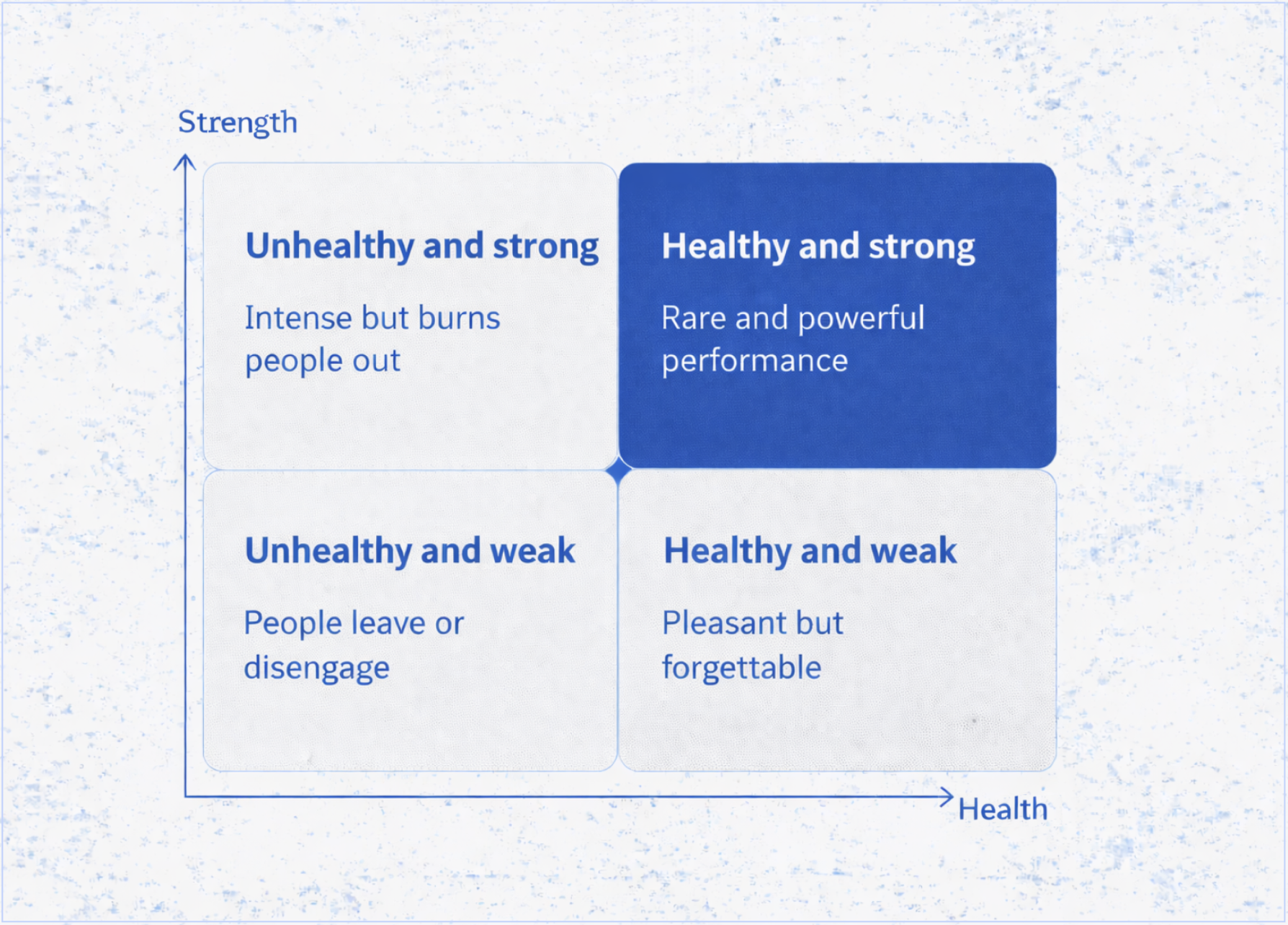
Put those two axes together and you get four kinds of cultures.
1) Healthy and strong.
This is the goal. It is rare, and it is powerful. People thrive, and the company has a clear identity. The culture becomes a recruiting advantage and an execution advantage.
2) Healthy and weak.
This is pleasant but forgettable. People feel safe, but there is no sharpness. No distinctive way of operating. It can be hard to scale because the company has no cultural spine.
3) Unhealthy and strong.
This is common in high pressure environments. The culture is intense and clear, but it burns people out. It can win in the short term. In the long term, it becomes a tax.
4) Unhealthy and weak.
This is the worst outcome. No belonging, no safety, no purpose, and no identity. People leave or disengage. The company drifts.
Most founders do not deliberately choose one of these. They stumble into one.
1) Healthy and strong.
This is the goal. It is rare, and it is powerful. People thrive, and the company has a clear identity. The culture becomes a recruiting advantage and an execution advantage.
2) Healthy and weak.
This is pleasant but forgettable. People feel safe, but there is no sharpness. No distinctive way of operating. It can be hard to scale because the company has no cultural spine.
3) Unhealthy and strong.
This is common in high pressure environments. The culture is intense and clear, but it burns people out. It can win in the short term. In the long term, it becomes a tax.
4) Unhealthy and weak.
This is the worst outcome. No belonging, no safety, no purpose, and no identity. People leave or disengage. The company drifts.
Most founders do not deliberately choose one of these. They stumble into one.
Take a stance, selectively
Some founders think strong cultures require being opinionated about everything. That is not true.
A company does not need to take a stance on every topic. But the best companies are opinionated in at least a few areas. They choose a handful of principles and operational norms that are unusually clear, and they enforce them consistently.
Strong cultures are often seen as unusual. They are supposed to be.
But the point is not to be weird. The point is to be clear. Clarity is rare.
A company does not need to take a stance on every topic. But the best companies are opinionated in at least a few areas. They choose a handful of principles and operational norms that are unusually clear, and they enforce them consistently.
Strong cultures are often seen as unusual. They are supposed to be.
But the point is not to be weird. The point is to be clear. Clarity is rare.
How to build it without overthinking
Culture building becomes simpler when you separate two tasks.
First, build health. Make it safe to tell the truth. Make it normal to admit mistakes. Make belonging real, not performative. Make purpose explicit, not assumed.
This is the foundation. Without it, everything else becomes politics.
Second, choose a few strong stances. Pick two or three areas where you will be unusually clear. How you work. How you communicate. What excellence looks like. What you do not tolerate. What you optimize for.
Then write it down. Reinforce it. Hire for it. Celebrate it. Protect it.
That is how culture becomes real.
First, build health. Make it safe to tell the truth. Make it normal to admit mistakes. Make belonging real, not performative. Make purpose explicit, not assumed.
This is the foundation. Without it, everything else becomes politics.
Second, choose a few strong stances. Pick two or three areas where you will be unusually clear. How you work. How you communicate. What excellence looks like. What you do not tolerate. What you optimize for.
Then write it down. Reinforce it. Hire for it. Celebrate it. Protect it.
That is how culture becomes real.
The mistake to avoid
Many founders try to build a strong culture without building a healthy one. They create intensity without safety. They create standards without belonging. They create pressure without trust.
That produces an unhealthy and strong culture. It works until it doesn't.
The other mistake is building a healthy culture and stopping there. That produces a place people like, but not a place that is uniquely capable.
Startup teams do not win by being pleasant. They win by being aligned.
That produces an unhealthy and strong culture. It works until it doesn't.
The other mistake is building a healthy culture and stopping there. That produces a place people like, but not a place that is uniquely capable.
Startup teams do not win by being pleasant. They win by being aligned.
Tear down your wallpaper values
Culture is not a poster. It is a system. Once you understand the 2x2, you can stop treating culture like an abstract concept and start treating it like a design problem.

Health is observable. Strength is a choice. If you get both right, culture becomes the thing that makes everything else easier.
Most founders wait, the best ones design culture early.
Most founders wait, the best ones design culture early.