Defining talent density
Talent density represents the share of exceptional performers inside a company. The higher the concentration, the stronger the company.

A select few companies at any point in time act as gravity wells for high performers. Facebook held that position in the late 2000s. Uber and Airbnb in the early 2010s. Stripe in the late 2010s. Today it is arguably OpenAI and Anthropic.
Talent density is what happens when the top of the performance spectrum makes up a meaningful percentage of the team. The five levels below are my working model for that spectrum. This framework is not peer reviewed or scientifically validated. It is just a tool, but it is useful.
Talent density is what happens when the top of the performance spectrum makes up a meaningful percentage of the team. The five levels below are my working model for that spectrum. This framework is not peer reviewed or scientifically validated. It is just a tool, but it is useful.
The five performer types
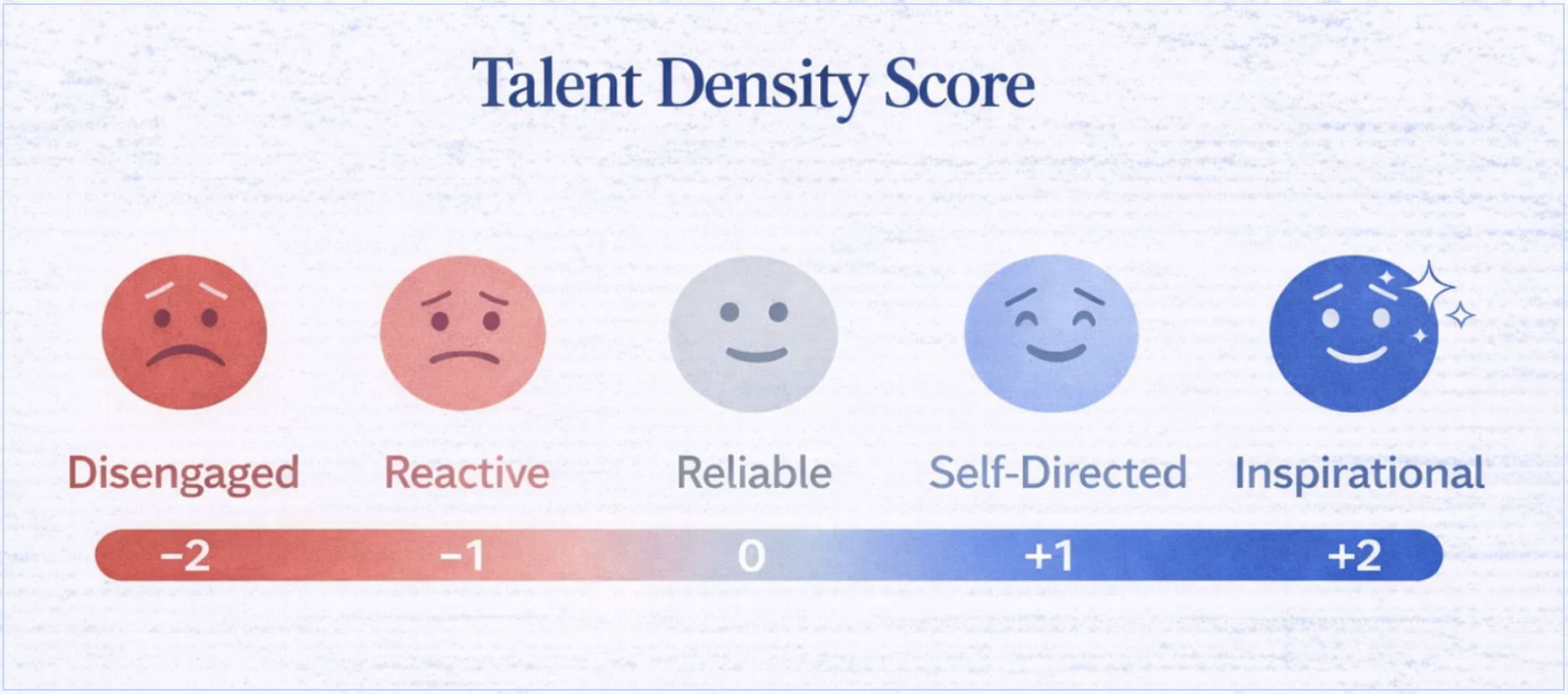
Disengaged
Meetings start before they arrive and action items die in their inbox. They need to be prodded multiple times to finish their work. The cost is not merely delayed execution. It is the permission their behavior grants everyone else to lower the bar.
Disengagement spreads.
Disengagement spreads.
Reactive
They execute when asked and instructed. Tasks get done, but quality is inconsistent and ownership is thin. They are often well intentioned. But they are essentially passive participants.
Reliable
Commitments are kept, details tracked, context remembered.
Hand them a deliverable and you can trust it will return complete and correct. They are sharp. They are consistently on top of it.
Reliable performers create operational stability.
Hand them a deliverable and you can trust it will return complete and correct. They are sharp. They are consistently on top of it.
Reliable performers create operational stability.
Self-directed
They soak up context, discern what matters, and start moving before anyone asks.
They preempt obstacles. They make decisions. They create momentum. Guided by high quality judgment, they take initiative and execute decisively.
Self-directed performers are engines.
They preempt obstacles. They make decisions. They create momentum. Guided by high quality judgment, they take initiative and execute decisively.
Self-directed performers are engines.
Inspirational
Their output is extraordinary, but their larger contribution is cultural.
They raise the overall effort, engagement, and output of the whole team. They become standard bearers. They recalibrate what “good” means.
Inspirational performers change what is expected and accepted.
They raise the overall effort, engagement, and output of the whole team. They become standard bearers. They recalibrate what “good” means.
Inspirational performers change what is expected and accepted.
What talent density actually is
Here is the key point: those five performer types are not evenly distributed across companies.

Inspirational and self-directed performers are rare, but they cluster. The best want to work with the best. A-players hire A-players.
Disengaged performers also cluster, for the same reason.
If a company tolerates disengagement, it becomes a repellent to high performers. The bar drops, top performers leave, and the people who remain normalize a lower standard.
That is the opposite of talent density.
Disengaged performers also cluster, for the same reason.
If a company tolerates disengagement, it becomes a repellent to high performers. The bar drops, top performers leave, and the people who remain normalize a lower standard.
That is the opposite of talent density.
How to measure it
You can make this concept more precise with a score, similar to NPS.
Assign each performance level a value:
- Disengaged: -2
- Reactive: -1
- Reliable: 0
- Self-Directed: +1
- Inspirational: +2
Then add up the values across the company and divide by the number of employees. That gives you a single number: your Talent Density Score.
A score above 1 is hard to achieve. It implies not only a meaningful share of high performers, but also very few detractors. In practice, great teams are defined by both.
More lift. Less drag.
Here is a rough interpretation:
- Poor: less than 0
- Ok: 0 to 0.5
- Good: 0.5 to 1
- Great: 1+
A 1+ threshold is extremely hard to sustain at scale, but it is achievable early. It is much easier to build a talent dense team of 8 than a talent dense team of 800.
That is one reason startups can routinely outperform incumbents with superior resources.
Startups do not come with many built-in advantages, but talent can be one of them.
Assign each performance level a value:
- Disengaged: -2
- Reactive: -1
- Reliable: 0
- Self-Directed: +1
- Inspirational: +2
Then add up the values across the company and divide by the number of employees. That gives you a single number: your Talent Density Score.
A score above 1 is hard to achieve. It implies not only a meaningful share of high performers, but also very few detractors. In practice, great teams are defined by both.
More lift. Less drag.
Here is a rough interpretation:
- Poor: less than 0
- Ok: 0 to 0.5
- Good: 0.5 to 1
- Great: 1+
A 1+ threshold is extremely hard to sustain at scale, but it is achievable early. It is much easier to build a talent dense team of 8 than a talent dense team of 800.
That is one reason startups can routinely outperform incumbents with superior resources.
Startups do not come with many built-in advantages, but talent can be one of them.
Composition design
Most leaders think talent density is about hiring. It is, but it is also about tolerance.
What you accept becomes the culture. Who you keep becomes the team.
Disengagement is not neutral. It is contagious. So is excellence.
Once you learn to see the performance spectrum clearly, you stop managing people as “great or not.” You start managing the distribution.
Talent density is not a vibe. It is a composition problem.
And composition is something you can design.
What you accept becomes the culture. Who you keep becomes the team.
Disengagement is not neutral. It is contagious. So is excellence.
Once you learn to see the performance spectrum clearly, you stop managing people as “great or not.” You start managing the distribution.
Talent density is not a vibe. It is a composition problem.
And composition is something you can design.